DeKalb County paying $16,500 to cover school meal debt
November 20, 2025
By Zoe Seiler | Decaturish
DECATUR, Ga. — DeKalb County CEO Lorraine Cochran-Johnson announced Nov. 17 that the county will pay about $16,500 to DeKalb County Schools to cover school meal debt.
“Today, it is also a great honor to affirm that DeKalb County is committed to our children,” Cochran-Johnson said. “DeKalb County has worked in partnership as a result of our commitment with DeKalb County Schools to pay off all outstanding school meal debt for DeKalb County School District.”
That will make accounts whole for 1,818 students.
“By eliminating this debt, we are ensuring that every child in DeKalb County has the ability to focus on learning, while parents who may be facing either challenges as a result of job displacement or simply a lack of resources don’t have to worry about whether or not they can afford meals for their children,” Cochran-Johnson said.
She told Decaturish that the inspiration to step in came from state Rep. Imani Barnes, D-Tucker. Barnes issued a letter to the school district on Oct. 30, urging them to temporarily halt alternative lunches to make sure that every student receives a full, nutritious meal regardless of their lunch balance.
Barnes recalled when City Schools of Decatur discussed implementing an alternate meal of a cheese sandwich if a family failed to pay a meal balance. The school district backed away from the cheese sandwich, but did put an alternate meal option in its school nutrition policy in 2024.
Barnes called on the DeKalb School District not to do the same during a federal Supplemental Nutrition Assistance Program funding.
“I was thanking them and then wondering if we could not send out those notifications to parents that are telling them that they have a negative balance during the SNAP freeze, and also see if we can reach out to community stakeholders to try to pay down those balances to help families out right now,” Barnes said.
Individuals who receive SNAP were at risk of losing benefits in November during a federal government shutdown. After a couple of court rulings, the United States Department of Agriculture issued partial benefits this month.
“It has people realizing that this doesn’t just affect one demographic or one party. This affects everyone,” Barnes said. “Now, everyone’s like, let’s make sure the kids are well fed while they’re in school because they are seeing how many people are really struggling, whether you’re on SNAP or not.”
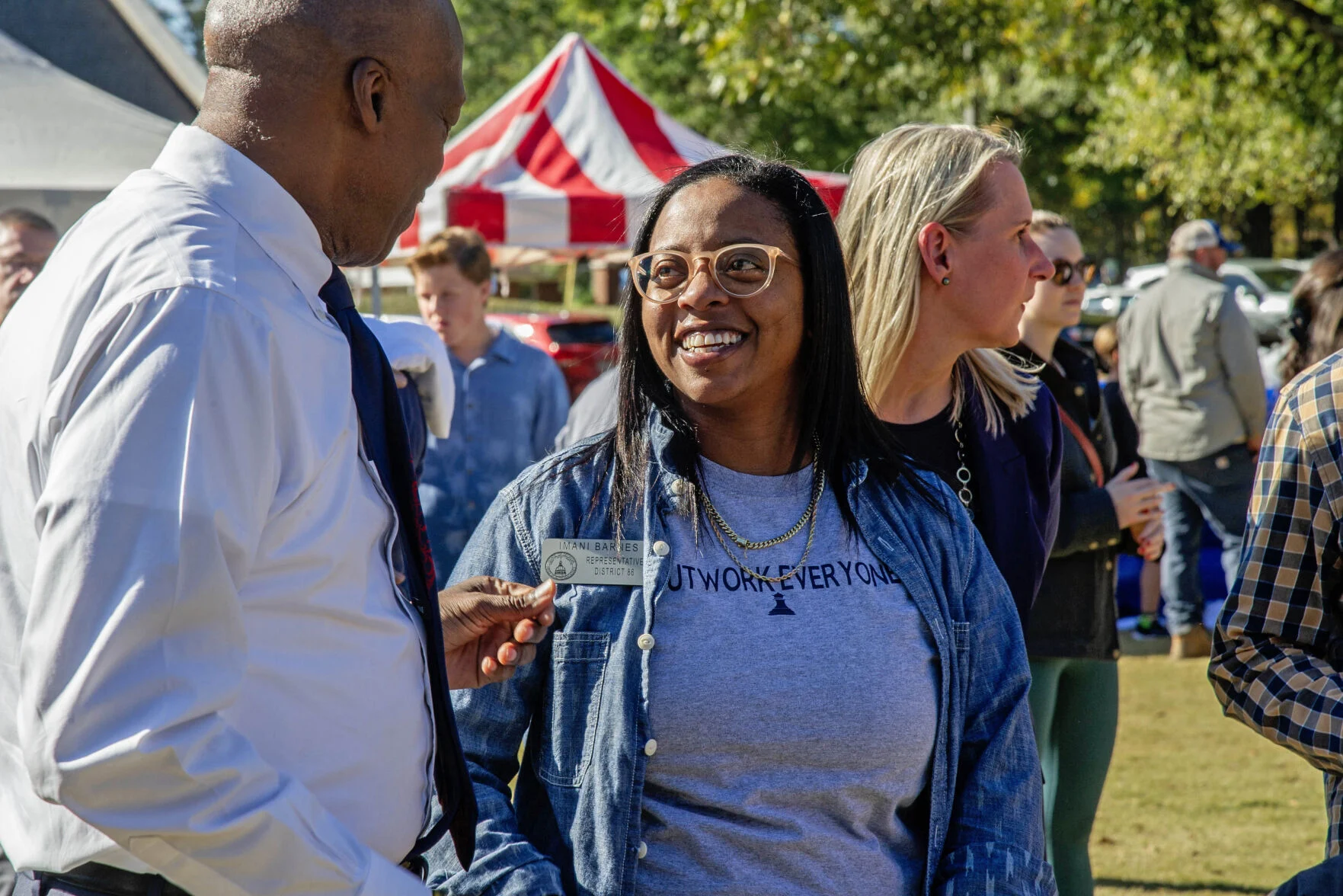
Barnes reached out to Cochran-Johnson’s office, and “this was the result.”
“This is what community is all about,” Barnes said. “This is what we expect from our commissioners and our CEO in our time of need, so I am thankful for CEO Cochran-Johnson’s swift action in answering the call.”
Cochran-Johnson previously said that the uncertainty around SNAP benefits will impact 54,000 households in DeKalb County, representing 127,000 residents.
Barnes is still trying to codify free school meals into law.
She is the sponsor of House Bill 60, the Healthy Start Act, which seeks to provide school breakfast and lunch at no cost to public school students in Georgia who qualify for free or reduced lunch.
“It recommends that we use Georgia Agriculture to do that. I’ve been trying to push it for the past three years,” Barnes said.
The bill has not received a committee hearing, but Barnes has helped secure $6.3 million in the state budget for school meals.
“We need to make it law for times like this,” she said. “If another SNAP freeze happens, we can ensure that our kids are still eating. Sometimes that is these kids’ only meal.”
According to a fiscal note for the bill dated Jan. 27, the bill could result in more than 86 million breakfast meals served for all students in Georgia. Federal funding now covers some of the cost of meals, and local school districts would be required to maximize their access to federal breakfast and lunch funds.
If federal funds were to stop, the state would need to spend $246.1 million to maintain the current federal school breakfast funding rate.
Barnes plans to continue focusing on HB 60 during the next session, which begins on Jan. 12, 2026.
“This session, I want to focus on codifying the Healthy Start Act into law because data has shown that a fed belly is a fed mind, so they’re able to succeed more if they’re fed healthy food, not just happy food,” Barnes said.
Join 1,900+ BIPARTISAN LEADERS NATIONWIDE
Be a part of a network of lawmakers committed to governing effectively, passing more representative public policy, and increasing public trust in democracy.