Getting on the Same Page: The Right-to-Read Movement in State Legislatures
November 5, 2026
By Harvey Solomon
Nearly 12,000 books were banned in U.S. public schools in the 2025-26 school year, according to PEN America – the most since the organization began compiling figures five years ago. The toll encompassed more than 7,000 individual titles representing the work of some 4,000 authors, illustrators and translators. First on the list? Stephen King.
“The impulse to censor is spreading,” said Kasey Meehan, PEN’s Freedom to Read director, adding that communities are mobilizing to stem the tide. “Most freedom-to-read bills come from a steady, grassroots-driven organization. Massachusetts is a great example of that drumbeat of powerful in-state advocates doing what they can to get in front of legislators, provide public comment and defend the right to read.”
That message resonated with Massachusetts state Sen. Julian Cyr, D-Provincetown, lead sponsor of An Act Regarding Free Expression that was signed into law by Governor Maura Healey in August. “Librarians in both our schools and public libraries are some of the most treasured people in our communities,” said Cyr, who represents 19 towns across Cape Cod and Martha’s Vineyard. “Libraries are a cornerstone, and it’s been really alarming to see this acceleration of political attacks.”
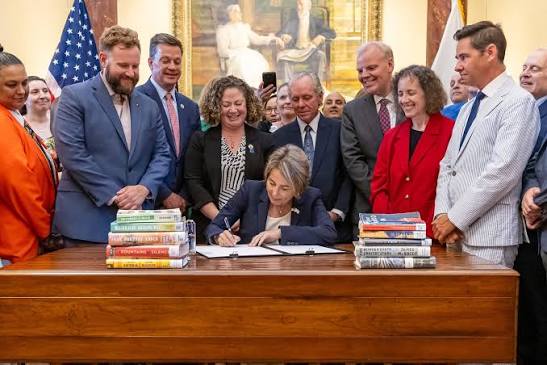
Existing laws provide inspiration—and sometimes outright templates—for bipartisan lawmakers pursuing pragmatic solutions. For Cyr, it all began at the most recent annual summit of the National Conference of State Legislators, when a fellow lawmaker told him about how in 2023, the Illinois House passed the nation’s first bill outlawing book bans. “Massachusetts has long been a national leader in education and learning. This legislation builds on that proud, longstanding tradition by ensuring that decisions about library collections are made by trained professionals through a transparent process, not by political pressure or intimidation.”
Like minds on both sides of the aisle have been coming together in many states. Delaware state Rep. Mike Smith, R-Newark, worked closely with sponsors Rep. Krista Griffith, D-Wilmington, and Sen. Elizabeth Lockman, D-Wilmington, to craft the First State’s Freedom to Read Act. “Krista’s district and mine are adjacent, and we’d already worked a lot together in the reading space,” said Smith, recipient of Future Caucus’ Rising Star Award in 2023. “The politics is simple. It’s when emotion gets involved that things can get complicated. By sitting down and hashing things out, getting to understand everyone’s intent, it all went very smoothly.”
A recent brouhaha in Tennessee suggests that even in states where emotions run
higher, common ground might be within reach. In 2024, state Rep. Gino Bulso, R-Brentwood, sponsored H.B. 1828, proposing 10 works as official state books of Tennessee. The list included Alex Haley’s seminal text, Roots, which Bulso described in the bill as “the most successful book ever penned by a Tennessean and largely responsible for reviving popular interest in family history.” Not two years later, however, the Knox County Board of Education banned the Pulitzer Prize-winning novel from school libraries, under the state’s Age-Appropriate Materials Act of 2022, of which Bulso was a proponent.
Public outrage ignited, and within weeks, the superintendent of Knox County schools announced the book would be returning to shelves—but not before a Board of Education resolution asked lawmakers to consider addressing every book’s historical, literacy, religious and educational significance. “This is not rewriting the law,” said board member Anne Templeton, one of the 5-4 majority. “This is asking to open up the conversation, to say, ‘Hey, this law resulted in this outcome. Do we agree with this, or do we not?’”
With Tennessee ranking only behind Texas and Florida in book banning, the Knox County controversy could inspire a more nuanced, less strident approach in other states. According to Madison Markham, PEN’s Freedom to Read program coordinator, the reversal of the Roots ban doesn’t necessarily portend the reversal of the Age-Appropriate Materials Act, but it could reduce the bill’s harm. “This is a really unique situation, something we haven’t seen so far to that degree,” she said. “Public comments made not just by Democrats but by at least one Republican legislator suggest movement towards amending that law.”
Traffic increasing on this often rocky two-way street suggests that anything is possible. “I know around the country this issue has become very partisan,” said Smith, “but I do my own thing. Ours was a very normal give-and-take process, hearing from state officials, librarians, local organizations and constituents. We all felt this was an important issue, and it was important for us as legislators to work together and get it done.”
That mindset hasn’t gone unnoticed. “Mike has that ability to go across the aisle,” said John Gordon, COO of the Delaware State Chamber of Commerce. “He has a track record of being able to speak with both sides and move issues forward.”
Maryland, Massachusetts and 10 other states – California, Minnesota, New Jersey, Vermont, Washington, Colorado, Connecticut, Delaware, Oregon and Rhode Island – have passed similar right-to-read bills. New York’s version now sits on Governor Hochul’s desk. Legislators in Alaska, New Mexico and Pennsylvania are exploring doing the same.
The paths to ratification are many, some more winding and precipitous than others. Unfortunately, this issue is not exempt from the rising tide of politically motivated threats of violence. “What has struck me most throughout this process has not been the books but the people we heard from,” said Cyr. “Librarians who’ve been threatened, harassed, doxed and driven from their jobs. One librarian in my district received death threats because of a children’s story time. I invited her to come to the State House to tell her story. She declined, not because her story wasn’t important, but because she was afraid.”
If there is a common thread among the states that have acted, it may be less about any single bill than about how the work got done: lawmakers sitting down, as Smith put it, to hash things out and understand one another’s intent. With New York’s bill awaiting a signature and several more states weighing their own, that process will be tested again in the months ahead, one committee room at a time.


Join 2,000+ BIPARTISAN LEADERS NATIONWIDE
Be a part of a network of lawmakers committed to governing effectively, passing more representative public policy, and increasing public trust in democracy.