From the Courthouse Steps to the Governor’s Desk: Rep. Justis Gibbs Gets Mississippi to Protect Incarcerated People from Toxic Chemicals
May 21, 2026
By Elizabeth Rosen
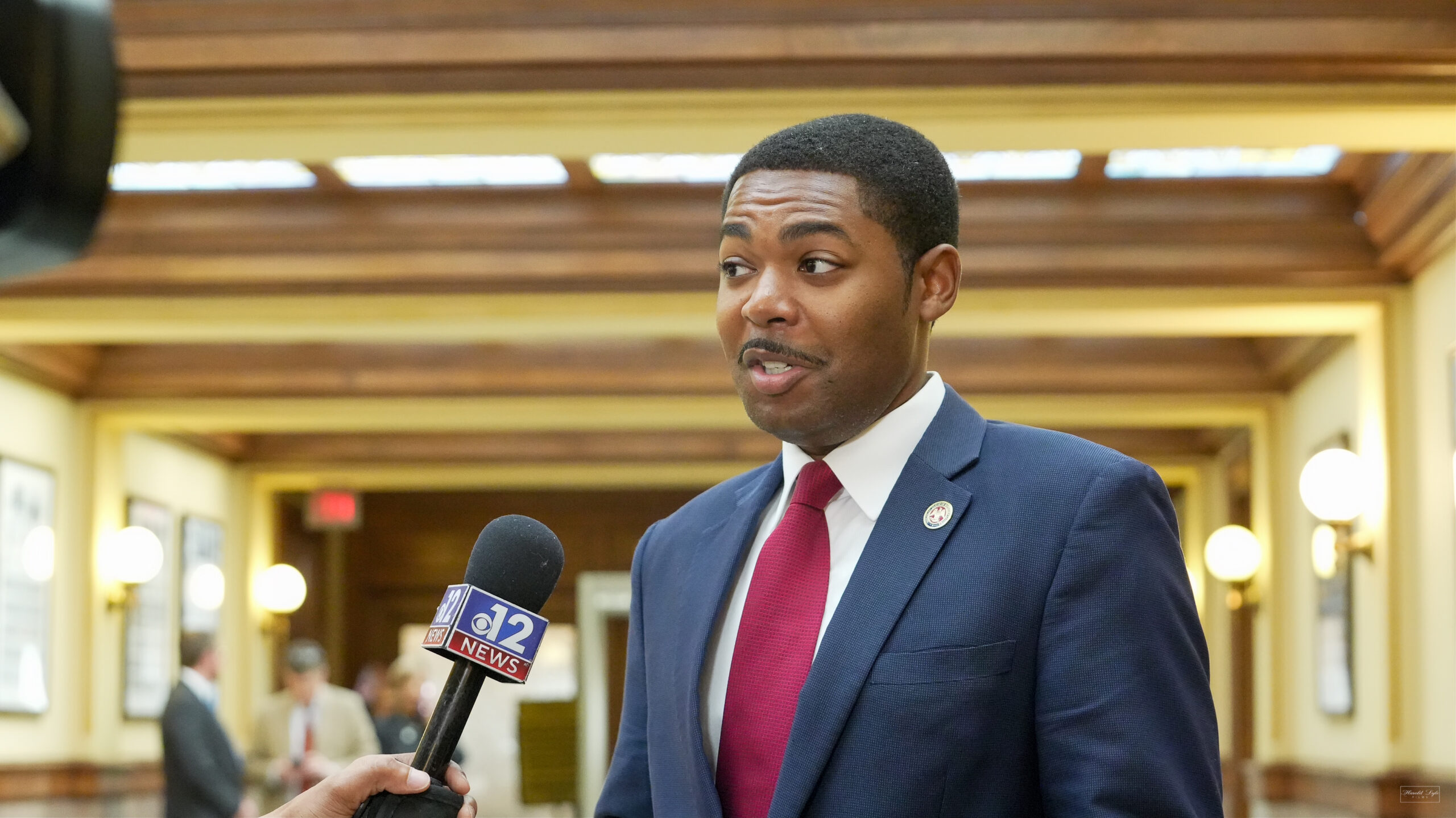
On a brisk late-winter morning in 2025, Rep. Justis Gibbs, D-72, stood on the steps of a federal courthouse in Jackson. Beside him were women who had survived Mississippi’s correctional system, though not unscathed. Propped around them were photographs of women who could not be there in person.
The photos showed what years of unprotected exposure to raw industrial cleaning chemicals does to a human body: Large lesions across women’s sides. Skin peeled from the soles of their feet so thoroughly that standing had become painful. The women pictured were plaintiffs in Mississippi’s first federal lawsuit brought by formerly incarcerated women, filed by the RECH Foundation. They alleged missed diagnoses, untreated conditions, and hours-long cleaning shifts using industrial chemicals with no gloves, no masks, no protection of any kind.
One of the women standing on those steps was Susie Balfour.
“Ms. Susie Balfour, who I stood with that day, who was the one who developed the terminal cancer,” Gibbs recalled. “A lot of people don’t know that she passed away last year from her cancer, and she lived a life of pain. There’s a lot of people who have lived a life of pain.”
Gibbs, an attorney and Democrat representing Hinds County, had been invited to hear these women’s stories. What he heard would become House Bill 1444, a law requiring the Mississippi Department of Corrections to maintain written policies governing cleaning and dangerous chemicals, and to ensure incarcerated people can read those policies at any time.
HB 1444 passed unanimously in both chambers and was signed into law in 2026. The path there was anything but smooth.
Early research revealed a glaring gap: no state law required correctional facilities to provide personal protective equipment for cleaning work. Whether a warden handed out gloves and masks was entirely up to that warden. A new administration had recently installed Commissioner Burrell Kane at the Department of Corrections, and Kane had quietly adopted an internal policy requiring some protections—likely, Gibbs suspected, with the looming lawsuit in mind. But internal policy is fragile. One commissioner makes it; the next can unmake it.
“If a new commissioner was in place, or if he had a change of heart, the important part is to ensure that we can codify this into state law so that that policy cannot be rescinded,” Gibbs said. “If it’s not us in the legislature who requires you to do this, we’re going to look up one day and a lot of these things will just vanish in the middle of the night.”
Working with the RECH Foundation and formerly incarcerated women, Gibbs drafted a first version listing specific acids, alkalines, and toxic compounds by name. Then he hit a wall: some of those same compounds appear in ordinary hand soap. Read literally, his bill would have required gloves and a mask to wash your hands.
That first version, House Bill 658, made it further than most freshman bills—through committee, through the House, into Senate committee—then died on the Senate floor, smothered by lobbyists for chemical vendors and attorneys worried about liability.
Gibbs didn’t simply file it again. He sat down with Commissioner Kane, studied the internal policy, and rebuilt the bill around a sharper idea. Instead of naming chemicals—a list anyone could pick apart—HB 1444 would require the department to maintain written policies for any cleaning or dangerous chemicals, accessible to incarcerated people at all times.
Paradoxically, stripping out the specifics made the law stronger. Tied to policy rather than a fixed list, it covers whatever chemicals might come next. And as an attorney, Gibbs knew a state statute gives lawyers something concrete to point to in court.
His political strategy was just as deliberate. Mississippi’s legislature is heavily Republican; Gibbs is a freshman Democrat in a superminority. HB 1444 had no Republican cosponsors, yet still passed unanimously. He worked one person at a time.
“We are very partisan in terms of policy, but we are very personable and friendly with one another,” he explained. “We are a hospitable state, and I think that if you can capitalize off of that, then you can get people’s buy-in with things that may not hurt them politically as much as they think, if they trust you.”
The Republican chairwoman of the House Corrections Committee became a reliable partner. So did Future Caucus member Rep. Elliot Burch, R-105, vice chair of the committee, who introduced the conference report on the House floor.
The bill nearly died anyway. A bitter feud between the chambers over school choice and sports betting had produced an unspoken pact of mutually assured destruction: each side was killing all the other’s bills.
“My bill was about to die,” Gibbs said. On one of the last days the Senate could still pull House-originated bills, he walked across the Capitol and asked Lieutenant Governor Delbert Hosemann’s policy director to flag it. At a luncheon a week later, Hosemann confirmed he’d intervened.
“Corrections is something that shouldn’t be a partisan issue,” Gibbs said. “There are conservatives and liberals, black and white folks, in these correctional facilities, and none of that should matter.”
Gibbs is careful not to overstate what the law does. It doesn’t end exploitation in Mississippi’s prisons, and he knows it. But durable change progresses in layers, and this layer cannot be peeled back by the next administration.
“I did this in honor of Ms. Balfour and all the ones who did not have the capacity to fight for themselves,” he said.
For a freshman Democrat in a legislature dominated by the other party, that is not a small thing to have written into law.


Join 2,000+ BIPARTISAN LEADERS NATIONWIDE
Be a part of a network of lawmakers committed to governing effectively, passing more representative public policy, and increasing public trust in democracy.